This detached villa stands in a quiet cul-de-sac in Ciudad Quesada, on the southern Costa Blanca in the province of Alicante. The house dates from 1970 and offers 84 m² of living space with two bedrooms, one bathroom, a separate kitchen and a lounge. Central heating and air conditioning are installed. The 486 m² plot includes a private swimming pool, an outdoor bar and several terraces. An underbuild offers potential for additional accommodation. The asking price is fixed at €310,000.
Key characteristics of location, homes, project phase and points of attention.
The villa lies in a residential area of Ciudad Quesada, roughly 27 km as the crow flies from Alicante-Elche airport. Within a 2 km radius there are some 25 restaurants, two pharmacies, three banks and a café. Elche is 22 km away in a straight line, Murcia 37 km. Golf courses at La Finca and Villamartín sit at 6.9 km and 14.9 km respectively.
The property suits a household seeking compact single-storey living with generous outdoor space. Two bedrooms and one bathroom keep the layout simple, while the 486 m² plot provides a private pool, bar area and multiple seating zones. Central heating and air conditioning cover year-round comfort. The underbuild allows for later expansion, subject to permissions.
This is not a new-build project. The villa was completed in 1970 and is offered key-ready as an existing home. The asking price of €310,000 is fixed and not a starting price. Buyers should budget for inspection and potential renovation, particularly of the underbuild, which is currently unfinished space rather than habitable accommodation.
The villa offers two bedrooms and a single bathroom, which limits capacity for larger households or guests until the underbuild is converted. There is no mention of a garage, and the 1970 construction means older installations that require technical verification. No sea view is indicated, and the site sits inland of the coastal strip at an elevation of 69 metres.
This property fits several recognisable situations. A couple seeking a manageable holiday home with substantial outdoor space will find the two-bedroom layout sufficient, while the pool and bar area support extended stays and visits from family. Retirees planning permanent residence benefit from the central heating and air conditioning, which allow comfortable use through winter and summer, and from the single-storey layout with no internal stairs. Buyers with an eye on adding value form a third group: the underbuild represents floor area that is not counted in the 84 m² living space, and converting it into a guest suite or additional bedrooms could increase capacity without extending the building footprint. Handymen and hobbyists may also value the workshop or storage potential. The property suits those who prioritise outdoor living and plot size over interior square metres; the ratio here is roughly 84 m² of house on 486 m² of land. It is less suitable for households needing three or more bedrooms immediately, or for buyers wanting a modern turnkey finish without any works. Those comparing with new-build alternatives in the same town should weigh the €310,000 asking price against starting prices of €322,000 and above, noting that the older property offers a larger plot and a private pool at a lower entry point, but with 1970s construction standards throughout.
The villa was built in 1970 in the Conchita style, recognisable by its white curved facade typical of that era of Spanish coastal construction. The photography shows a well-maintained exterior with boundary wall and entrance lamp, a mature garden layout and a covered gazebo with dining area. The interior images show a functional bathroom with tub, shower attachment and sink. Specifics of the kitchen and lounge finishing are limited; the description confirms a separate kitchen and a spacious lounge, both typical of the period's layout with clearly divided rooms rather than open-plan spaces. Installed comfort systems include central heating and air conditioning, a combination that covers both seasons and is not always present in properties of this age. Technical verification is advisable for the heating installation, electrical wiring and plumbing, all of which may date wholly or partly from the original construction or later upgrades. The underbuild is the main structural consideration: it exists as shell space with conversion potential, and its current condition, floor levels, damp proofing and ventilation would need assessment before any habitable use. Roof structure and insulation of a 1970 villa also warrant inspection. No energy performance details are available in the provided data. Overall, the finishing level is that of a cared-for older home rather than a renovated property, and buyers should view it with a surveyor's perspective.


The villa is offered as an existing home with a fixed asking price of €310,000. This positions it below the new-build developments currently marketed in Ciudad Quesada, where comparable projects start from €322,000 for bungalows and from €364,000 to €373,000 for villas in the Lo Marabú area. The price difference reflects age and specification: a 1970 property with 84 m² of living space against modern turnkey construction. Availability is immediate, as the home is key-ready. Buyers comparing options should factor in renovation costs, particularly for the underbuild conversion, when measuring value against new-build alternatives.
Daily life at this property centres on its outdoor space as much as its interior. The house itself is compact: 84 m² containing a lounge, a separate kitchen, two bedrooms and one bathroom. The plot, however, measures 486 m² and is laid out as a series of zones, with a private pool at its heart, an outdoor bar, a covered dining gazebo and several terraces for sunbathing or shade. For a household that lives outdoors for much of the year, this balance works: mornings can start on the terrace, afternoons around the pool, and evenings at the bar or dining area under the gazebo. The interior serves as a practical base rather than the main living environment. Ciudad Quesada itself is a residential urbanisation with an international population, and the streets around the cul-de-sac are quiet outside the summer months. Shops, restaurants and services are within a short drive or, for several of them, walking distance: the 2 km radius includes 25 restaurants, pharmacies and banks. The climate supports this outdoor rhythm, with average monthly temperatures ranging from 12°C in winter to 26°C in summer and a swimming season of about five months at water temperatures of 20°C or above. Public transport exists in the form of nine lines serving five stops, though most residents rely on a car for groceries, the beach and wider travel. The underbuild adds a second layer of possibility: a guest suite, office or entertainment room could be created there, which would change how the property functions day to day.
Ciudad Quesada functions as a self-contained residential town with a mixed international and Spanish population. The immediate surroundings of the villa, a cul-de-sac, provide a low-traffic environment. Amenities within a 2 km radius include approximately 25 restaurants, two pharmacies, three banks, a café and a dentist, which covers most daily needs without leaving the urbanisation. For sport, the Centro Deportivo La Raqueta sits 3.4 km away and the municipal Polideportivo El Molino 3.5 km, both measured in a straight line. An Iberdrola electric vehicle charging point is located at the Oasis Center, 3.8 km away, relevant for EV owners. Larger urban centres are reachable by car: Elche, with around 235,000 inhabitants, lies 22 km as the crow flies; Alicante with roughly 339,000 inhabitants is 38 km away, and Murcia with about 463,000 inhabitants 37 km. Public transport is modest, with nine lines and five stops, so a car is the practical mode of transport for most residents. The setting is inland of the coastal dune strip, at an elevation of 69 metres, which means flat terrain and no steep access roads, but also no direct sea views from the property.
The map shows the villa's position within Ciudad Quesada, an inland residential town set between the salt lakes and the dune beaches of the southern Costa Blanca. Note that distances to beaches, golf courses and airports are straight-line measurements; road routes are longer. The Alicante, Murcia corridor and the AP-7 motorway connect the area with both regional capitals.

Approximate area · exact address shared on request
Ciudad Quesada occupies a position on the southern Costa Blanca, in the province of Alicante, between the coastal towns of Torrevieja and Guardamar del Segura and inland towards the Orihuela interior. Within the regional hierarchy it sits closer to Alicante (38 km) than to Murcia (37 km), effectively equidistant between the two provincial capitals. The town is part of the Rojales municipality. Compared with the Costa del Sol further west, this stretch of coast offers lower price levels, reflected in the provincial median income of €15,750, and a landscape defined by salt lakes, dune beaches and golf valleys rather than mountain-backed resort towns.
The nearest marina, Port Esportiu Marina de les Dunes, is 7.6 km away as the crow flies, providing the closest coastal access point by road. Two golf courses serve the area: Club de Golf La Finca at 6.9 km and Club de Golf Villamartín at 14.9 km straight-line distance. Alicante-Elche Airport (ALC) lies approximately 27 km away, making flights accessible within a short drive for international owners; Valencia Airport is around 159 km and Málaga-Costa del Sol around 369 km. Road access follows the regional network connecting Ciudad Quesada with Torrevieja and the AP-7 corridor. Within the town itself, the amenities cluster near the commercial centre, reachable in minutes by car. Public transport consists of nine lines across five stops, sufficient for occasional trips but not a substitute for a vehicle. Distances mentioned are straight-line figures, and actual road distances will be somewhat longer.
| Alicante-Elche (ALC) | 27 km |
| Valencia (VLC) | 159 km |
Source: OpenStreetMap, Google Maps
The local climate is Mediterranean with an average annual temperature of 18.8°C. Monthly averages range from 12°C in the coolest months to 26°C in summer, which translates to mild winters where outdoor terraces remain usable most days, and hot summers where the pool and shaded gazebo become essential. The swimming season lasts about five months, with sea water at 20°C or warmer. The elevation of 69 metres means the site sits on flat terrain at the edge of the salt lake lowlands, with no slopes to negotiate on foot or by bike. Rainfall is concentrated in the autumn months, typical for the southern Costa Blanca. The surrounding landscape combines urbanised zones with the natural park of the salt lakes of Torrevieja and La Mata nearby, an area known for birdlife including flamingos. The Mediterranean coastline with its dune beaches lies a short drive to the east.
Source: Open-Meteo (2020–2025 average)
Coastal recreation centres on the beaches of Guardamar del Segura and Torrevieja, reachable within a short drive via the Marina de les Dunes area at 7.6 km straight-line distance. The dune-backed beaches of this stretch of coast are among the widest on the Costa Blanca, backed by a pine forest. For golfers, Club de Golf La Finca at 6.9 km is an 18-hole course set in a valley, while Club de Golf Villamartín at 14.9 km is another established championship course. Daily sports facilities include Centro Deportivo La Raqueta at 3.4 km, focused on racket sports, and the municipal Polideportivo El Molino at 3.5 km, offering general sports infrastructure. A taekwondo club sits 5 km away. The villa's own pool covers the swimming need at home, and the outdoor bar and barbecue area support social recreation on the plot itself. The region records 32 local public holidays per year, reflecting an active calendar of fiestas and events in the surrounding towns.
Source: OpenStreetMap
Quesada is a district of the San Carlos canton, in the Alajuela province of Costa Rica. It is the head city of the canton of San Carlos. Although Ciudad Quesada is the official name, it is commonly referred to by the area name of San Carlos. Ciudad Quesada is also the most populous city in the canton of San Carlos.
| Month | Avg. Temperature | Rainfall |
|---|---|---|
| January | 11.9°C | 23 mm |
| February | 12.6°C | 14 mm |
| March | 14.6°C | 26 mm |
| April | 16.6°C | 23 mm |
| May | 19.7°C | 15 mm |
| June | 23.2°C | 12 mm |
| July | 26.1°C | 1 mm |
| August | 26.4°C | 12 mm |
| September | 23.7°C | 52 mm |
| October | 20.1°C | 26 mm |
| November | 15.6°C | 37 mm |
| December | 12.3°C | 30 mm |
Ref: VL191681
Source: Wikipedia, Wikidata, INE, Junta de Andalucía
Within Ciudad Quesada itself, the market currently combines resale properties of the 1970s, 1990s with phased new-build development. Three comparable projects illustrate the new-build price level: AREA BEACH V LO MARABÚ Phase 1 and 2 from €364,000, Phase 3 and 4 from €373,000, and LO MARABU BUNGALOWS Phase 2 from €322,000. Against these, the villa's fixed price of €310,000 sits at the bottom of the range, despite offering a detached structure and a private pool on a 486 m² plot, features that new-build bungalows at similar prices do not include. The trade-off is age: 1970 construction against modern building standards, and a single bathroom against the two or more bathrooms typical of new builds. Regionally, the southern Costa Blanca around Torrevieja, Guardamar and Orihuela Costa remains one of the lower-priced coastal zones of mainland Spain. The provincial median income of €15,750 supports this picture of a cost-conscious market. Distances to the two provincial capitals, Alicante at 38 km and Murcia at 37 km straight-line, place the town at a practical midpoint, with Alicante-Elche airport only 27 km away. Golf infrastructure is a regional strength, with La Finca and Villamartín within 15 km. Compared with the Costa del Sol around Marbella and Estepona, where plot-based villas command substantially higher prices, this area offers older detached housing at entry levels closer to apartment prices elsewhere on the Spanish coast. For buyers weighing resale villa against new-build, the decision in Ciudad Quesada comes down to plot size and outdoor space versus turnkey condition and warranty coverage.
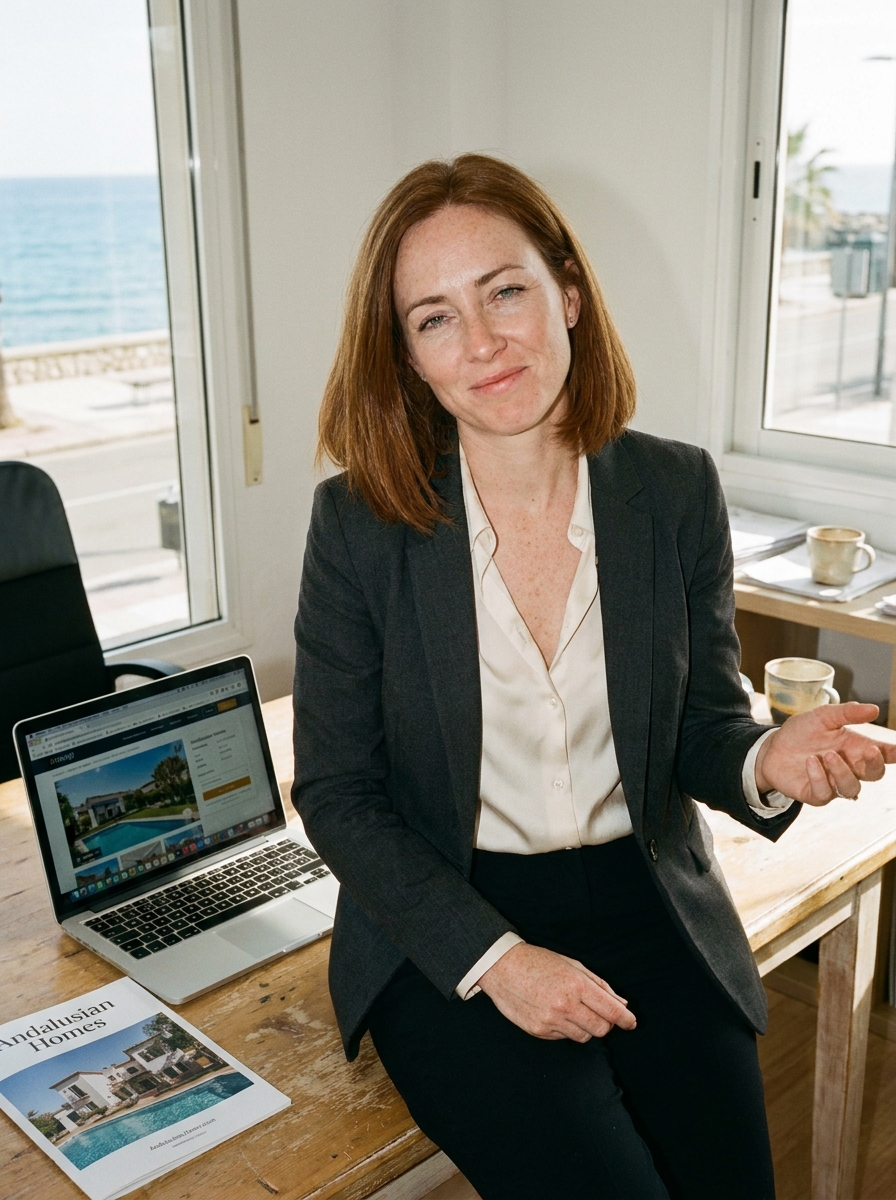
With years of experience, Emma Whitfield expertly guides English-speaking clients through the intricacies of the Spanish property market. Her dedication ensures a smooth journey.
AI-assisted multilingual representative. Your inquiry is handled by the team behind this site.
Interested?
Leave your details and we will contact you shortly with more information about this project.