
This key-ready townhouse is situated in Ciudad Quesada, a residential urbanisation in the municipality of Rojales on the southern Costa Blanca, roughly 27 km as the crow flies from Alicante-Elche Airport. The property offers two bedrooms, one bathroom, 81 m² of living space across two floors, two terraces and central air conditioning. It forms part of a private residential complex with a communal pool and resident parking. The asking price is fixed at €195,000. Ciudad Quesada itself functions as a self-contained village with supermarkets, restaurants, banks and pharmacies within walking and short driving distance.
Key characteristics of location, homes, project phase and points of attention.
Ciudad Quesada lies inland from the coastal strip of Guardamar del Segura, at about 69 metres above sea level. Within 2 km there are 25 restaurants, two pharmacies, three banks and a café. Larger cities, Elche (22 km), Murcia (37 km) and Alicante (38 km), all straight-line distances, surround the area. The marina at Marina de les Dunes sits 7.6 km away as the crow flies.
The house is arranged over two floors: a living room, bathroom and separate kitchen with rear terrace and utility area below, two bedrooms and a full bathroom above. One bedroom opens onto a private terrace overlooking the pool. The property comes fully furnished and includes a private garden area, which limits initial furnishing costs for a second home or permanent move.
This is not new construction. The house was completed in 1970 and is offered key-ready as an existing home, meaning the buyer can move in immediately after purchase. Delivery dates for existing properties follow the standard Spanish notarial process rather than a developer's construction schedule. The 1970 construction year means building techniques and installations predate current standards.
The property has one bathroom rather than two, an 81 m² living area typical of an older townhouse, and no private pool, only the communal pool of the complex. Parking is available for residents but spaces are not assigned to individual homes. There is no lift, so the two upstairs bedrooms are reached by stairs. The property does not include a private garage title.
Ref: VL891803
Source: Wikipedia, Wikidata, INE, Junta de Andalucía
This property fits several recognisable situations. A retired couple seeking a compact, affordable permanent home on the Costa Blanca with year-round services nearby would find the two-bedroom layout adequate, provided a single bathroom is acceptable. The full furnishing and key-ready status also suit buyers of a second home who want a property usable from day one without renovation work or furnishing projects. It also matches buyers with a budget around €200,000 who prioritise outdoor space and a pool over interior surface: the two terraces, private garden area and communal pool deliver those elements at a price point where new-build alternatives in the region typically offer apartments rather than townhouses. The property is less suitable for households needing two bathrooms, a private garage title or modern construction standards, the 1970 build year and single-bathroom layout are the main constraints. Buyers planning extensive daily commuting to Alicante city (38 km straight-line) should also weigh car dependence: public transport exists but is limited. For a rental-investment scenario, the combination of a furnished, key-ready townhouse in a services-rich urbanisation near golf courses and beaches is workable, though returns depend on the local rental market and the fact that parking is unassigned. In short, the property serves practical, budget-conscious buyers more than buyers seeking contemporary specification.
As a resale property completed in 1970, this townhouse reflects the building practices of its era rather than current new-build standards. The listing indicates central air conditioning, which covers heating and cooling throughout the year, a meaningful comfort feature in an older property, since 1970s townhouses on the Costa Blanca were often built without any integrated climate system. The layout is conventional for the period: a separate kitchen at the rear, a living room at the front, a bathroom on each living level, and bedrooms upstairs. The presence of a utility room on the rear terrace is a practical feature, keeping laundry equipment out of the main house. Both terraces, one at the entrance facing the communal areas, one off a bedroom overlooking the pool, extend the usable space beyond the 81 m² interior. The property is sold fully furnished, which in practice means the interior is usable immediately, though the age and condition of the furniture is a matter for inspection. Buyers of 1970s Spanish townhouses commonly check plumbing, electrical wiring, window frames and insulation, as these elements may have been updated at different times by previous owners. The listing does not state which installations have been renewed. The communal fabric, pools, walkways and parking areas, is managed by the community of owners, and its state of maintenance is typically verified during a viewing or through community documentation. In summary, the finishing level is that of a maintained, furnished resale home rather than a renovated or new construction, and buyers should budget for inspection and possible updates.


The asking price is fixed at €195,000 for this existing, key-ready townhouse. This is not a developer price list, so there is no range of unit types or from-price; the figure applies to this specific house with its two bedrooms, one bathroom, 81 m² of living space, two terraces, private garden area and full furnishing included. For context in the wider area, comparable new-build projects start from about €160,000 in Torrevieja (Palangre Beach) and €169,000 (Sun & Center), while Oasis Laguna 2 in nearby El Raso starts from €227,000. Older resale stock such as this 1970 townhouse typically prices below new construction per square metre. Availability is immediate upon completion of the standard Spanish purchase process; delivery timing after a resale purchase depends on the notary schedule and any agreed handover date, and all dates remain indicative.
Daily life in this townhouse follows the rhythm of a compact residential community. The morning can start on the rear terrace, where the laundry area is located, keeping household tasks out of the main living space. The kitchen is separate and connects directly to this terrace, which suits buyers who prefer a closed kitchen over an open-plan layout. Upstairs, one bedroom has a private terrace looking onto the communal pool, giving outdoor space on both levels of the house. The complex itself determines part of the living experience: shared pools, communal areas and shared parking. Residents without an assigned space rely on availability within the complex or on-street parking nearby. For a household of two, the two-bedroom, one-bathroom layout works for permanent residence or as a holiday base, though a second bathroom is absent. Ciudad Quesada operates as a year-round village rather than a summer-only resort. Within 2 km, the data shows 25 restaurants, two pharmacies, three banks and a dentist, so most daily errands can be done on foot or by a short drive. The centre of the urbanisation has a commercial strip, and the surrounding area is flat, which makes walking and cycling practical. The location sits back from the coast at about 69 metres elevation, which means sea views are limited but the immediate terrain is level. The nearest marina, Marina de les Dunes, lies 7.6 km away as the crow flies, so beach outings require a car of roughly ten minutes. Public transport exists, nine lines and five stops in the dataset, but coverage is modest by urban standards, and most residents use a car for regional trips.
Ciudad Quesada is a planned urbanisation in the municipality of Rojales, developed from the 1970s onwards into a full-service residential village. The dataset counts 25 restaurants, two pharmacies, three banks, one café and a dentist within 2 km, which places nearly all daily needs within a short walk or drive. The area is home to a large international resident population, and services operate year-round rather than seasonally. The terrain sits at about 69 metres above sea level and is largely flat, making the area walkable and cycle-friendly. The nearest coastal facility is the Port Esportiu Marina de les Dunes, 7.6 km away as the crow flies, with the beaches of Guardamar del Segura in the same direction. Two sports centres, Centro Deportivo La Raqueta at 3.4 km and Polideportivo Municipal El Molino at 3.5 km straight-line, cover indoor sports locally. Regional connections run through the AP-7 and N-332 corridors: Elche is 22 km away in a straight line, Murcia 37 km and Alicante 38 km. Alicante-Elche Airport lies roughly 27 km as the crow flies, typically around thirty minutes by car. Public transport within the dataset comprises nine lines and five stops, sufficient for local trips but not a substitute for a car. Nine public-holiday days per year, 32 local festive days in the dataset, and a swimming season of five months with sea temperatures at or above 20°C frame the local calendar for residents.
The map shows Ciudad Quesada set back from the coast between Guardamar del Segura and Torrevieja. Note that all distances shown are straight-line; actual road distances are somewhat longer. Alicante-Elche Airport lies to the north-east, roughly 27 km as the crow flies.

Approximate area · exact address shared on request
Ciudad Quesada occupies a middle position on the southern Costa Blanca: inland from Guardamar del Segura, north of Torrevieja and the Orihuela Costa, and roughly equidistant in straight-line terms from Elche (22 km), Murcia (37 km) and Alicante (38 km). This places it within reach of two provincial capitals and their airports via Alicante-Elche (about 27 km straight-line). Compared with the immediate coastal strip, the area offers lower density and lower price levels, while remaining within a ten-minute drive of the sea. Within the region, it competes directly with Torrevieja and the urbanisations of Orihuela Costa for the same buyer profile.
Access to this location is primarily by car. Alicante-Elche Airport (ALC) is approximately 27 km away as the crow flies, one of the shortest airport distances on the southern Costa Blanca; Valencia airport lies 159 km straight-line and Málaga around 369 km, so Alicante is the practical gateway. Road distances are longer than straight-line figures, as is usual. The nearest beach and marina facilities lie in the Guardamar direction: Marina de les Dunes at 7.6 km straight-line, reachable in roughly ten minutes' drive. Golfers have two courses within a short radius, Club de Golf La Finca at 6.9 km and Club de Golf Villamartín at 14.9 km, both straight-line distances. An EV charging point at the Iberdrola Oasis Center sits 3.8 km away, relevant for electric-vehicle owners. Local public transport exists with nine lines and five stops in the dataset, covering connections within the urbanisation and towards surrounding towns such as Torrevieja and Guardamar. Frequency and coverage are modest compared with city networks, so most residents rely on a private car for commuting, shopping beyond the village and airport transfers. Within Ciudad Quesada itself, the flat terrain and concentration of shops mean many daily trips can be made on foot.
| Alicante-Elche (ALC) | 27 km |
| Valencia (VLC) | 159 km |
Source: OpenStreetMap, Google Maps
The climate data for this location shows an average annual temperature of 18.8°C, with monthly averages ranging from 12°C in the coolest months to 26°C in summer. This is a typical semi-arid Costa Blanca profile: mild winters with little frost, warm summers, and low rainfall concentrated outside the summer season. The swimming season lasts about five months, during which sea temperatures reach or exceed 20°C, roughly May through September or early October. For a property with a communal pool, this defines the realistic outdoor-swimming window; the pool is not heated, so use outside this period depends on weather. The elevation of 69 metres places the house on gently rising ground behind the coastal plain. The practical consequences are level surroundings, no steep walks to shops or parking, and a slightly buffered position relative to coastal humidity, while sea views and sea breeze are less present than at the waterfront itself. The area around Ciudad Quesada includes the salt lakes of Torrevieja and La Mata to the south and agricultural land of the Vega Baja inland, giving the region an open, low-density landscape rather than dense coastal development.
Source: Open-Meteo (2020–2025 average)
The nearest coastal recreation hub is the Port Esportiu Marina de les Dunes, 7.6 km away as the crow flies, with the beaches of Guardamar del Segura along the same stretch of coast. These wide sandy beaches are among the most extensive in the province, backed by a pine forest, and form the main summer destination for Ciudad Quesada residents. Golf is a defining leisure option of the area. Club de Golf La Finca in Algorfa lies 6.9 km away in a straight line and is regarded as one of the region's established 18-hole courses; Club de Golf Villamartín, 14.9 km away, sits within the Orihuela Costa golf cluster. Together with the courses near Torrevieja, this places the property within a quarter-hour to half-hour drive of several options. For everyday sport, Centro Deportivo La Raqueta (3.4 km) and the Polideportivo Municipal El Molino (3.5 km) offer local facilities, and a taekwondo club operates at 5.0 km. Walking and cycling are practical on the flat terrain, with trails around the Torrevieja and La Mata salt lakes, a nature reserve popular with walkers and birdwatchers, a short drive south. The five-month warm-water season supports the full range of seaside recreation, from swimming to paddleboarding, for nearly half the year.
Source: OpenStreetMap
Quesada is a district of the San Carlos canton, in the Alajuela province of Costa Rica. It is the head city of the canton of San Carlos. Although Ciudad Quesada is the official name, it is commonly referred to by the area name of San Carlos. Ciudad Quesada is also the most populous city in the canton of San Carlos.
| Month | Avg. Temperature | Rainfall |
|---|---|---|
| January | 11.9°C | 23 mm |
| February | 12.6°C | 14 mm |
| March | 14.6°C | 26 mm |
| April | 16.6°C | 23 mm |
| May | 19.7°C | 15 mm |
| June | 23.2°C | 12 mm |
| July | 26.1°C | 1 mm |
| August | 26.4°C | 12 mm |
| September | 23.7°C | 52 mm |
| October | 20.1°C | 26 mm |
| November | 15.6°C | 37 mm |
| December | 12.3°C | 30 mm |
Within its immediate market, this townhouse competes with both new-build and resale stock in Torrevieja, El Raso and the Orihuela Costa. New-build comparables include Palangre Beach in Torrevieja (apartments from €160,000), Edificio Sun & Center, also key-ready in Torrevieja (from €169,000), and Oasis Laguna 2 Phase II in Urbanización El Raso (from €227,000). Against these, the €195,000 asking price positions this property between the entry-level new-build apartments of Torrevieja and the larger units of El Raso. The trade-off is explicit. New-build apartments at €160,000–€169,000 offer modern construction, current energy standards and typically one outdoor space, but smaller footprints and communal living without garden use. This townhouse offers more typology for the money in practical terms: two floors, two terraces, a private garden area and a townhouse rather than apartment format, but with 1970 construction, one bathroom and no developer warranty. Locationally, Ciudad Quesada differs from Torrevieja in character. Torrevieja is a denser, more urban coastal city with 80,000+ residents, heavier summer tourism and direct beachfront living; Ciudad Quesada is an inland urbanisation at 69 metres elevation, quieter, flatter and organised around a village centre, roughly ten minutes by car from the sea. El Raso, the third comparator, sits closer to the La Mata natural park with a more rural profile and higher new-build pricing. For the regional buyer profile, northern Europeans seeking an affordable second home or relocation base, the southern Costa Blanca as a whole trades at visibly lower prices than the Costa del Sol to the west, while sharing the same climate profile in the dataset (12–26°C monthly averages, 18.8°C annual mean). Median provincial income of €15,750 also signals a lower local cost base than Marbella-side markets, which reflects in community fees and everyday spending. Buyers comparing this property against new-build alternatives are, in effect, weighing typology and outdoor space against construction age and specification, the defining choice in this segment of the Alicante market.
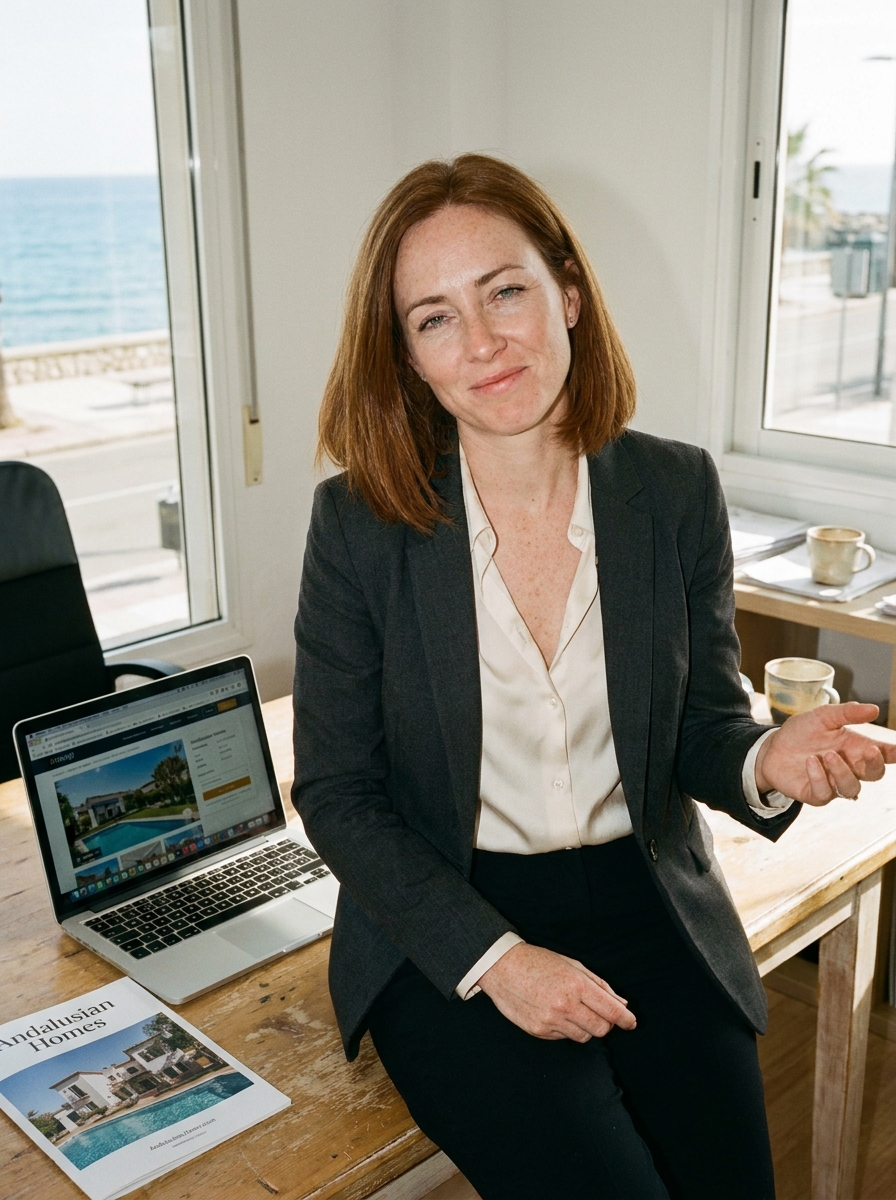
With years of experience, Emma Whitfield expertly guides English-speaking clients through the intricacies of the Spanish property market. Her dedication ensures a smooth journey.
AI-assisted multilingual representative. Your inquiry is handled by the team behind this site.
Interested?
Leave your details and we will contact you shortly with more information about this project.



 NL
 EN
 DE
 FR
 ES
 IT
 PT
 DA
 SV
 NO
 FI
 PL
 ZH
 RU
 AR
 TR
 CS
 RO
 HU
 LT
 ET
 BG
 HR
 SK
 JA
 KO
 HI
 UK
 EL
 SL
 LV
 ID